
SURAYYN SELVAN
Bachelor of Science (Honors) Architecture E-Portfolio

Project 1:
JOURNEY OF THE 5 SENSES
This project was divided into two parts. In groups of 5, the first part was the precedent study analysis of the poetics and spatial typologies in architecture. The second part was the proposal of a "walk themed" journey for the 5 senses based on the themes of the poem of our choice. Project 1A required us to identify and analyse the spatial orders and spatial poetics of two architectural precedents, where one would be a Pre-Modern Movement and the other is Contemporary. One of the precedents would have to be of a linear typology and the other would have to be of a concentric typology. We chose to study the Taj Mahal and the School of Music in Lisbon. The second part of our project required us to create two "walk themed" journeys of two different typologies which are linear and concentric. We were required to choose a poem and analyse it in an architectural viewpoint. The linear spatial typology would have to be a maximum of 50m in length and the concentric spatial typology was limited to a 10m X 10m X 10m space. The poem we decided to choose was Himadri Singha's, The Wall. Through these assingments, I am able to explain and identify the different spatial typologies in architecture and their spatial uses and experiences. I am also able to highlight the important ideas in precedent studies that could inform my design project. I am also able to conceptualize literature into an architectural form by considering section-plan relationships in relation to the human scale, natural light, materiality and textures. Finally, I am able to produce the relevant drawings and models and present them in order to communicate and visualize the architectural design idea.
The main themes for Architecture Design Studio 3 are the poetics of place and the experiential qualities of space in architecture. We were introduced to different spatial typologies and poetics in architectural spaces as well as the concept of neighborhood and community. The project works focused around these ideas and we were to explore the idea of plan-section integration to achieve an architectural form that is both tectonically expressive, functional and responsive to its site. Through this module, I am more aware of the idea of a genius loci in a space and the appropriate design responses towards the space. I was also able to emphasize the importance of the site and introduce the relevant spatial typologies in the design.
ARC2118
Architecture Design Studio 3
Project 1A:
PRECENDENT STUDIES
The slideshow containing our analysis


Our presentation boards for the Taj Mahal
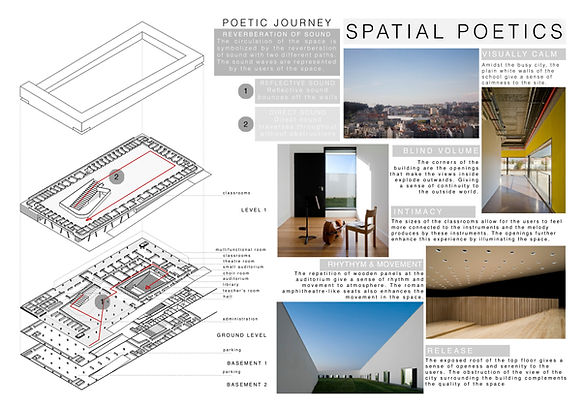
Our presentation boards for the School of Music, Lisbon
Project 1B:
THE JOURNEY FOR THE 5 SENSES


Our presentation boards for the Linear Typology of the walkthrough of The Wall.


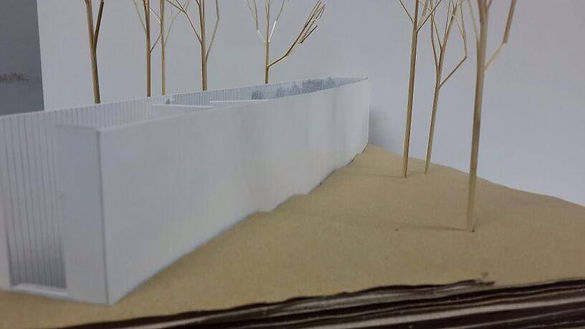
Our conceptual model for the linear walkthrough of The Wall


Our presentation boards for the Concentric Typology of the walkthrough of The Wall.


Our conceptual model for the concentric walkthrough of The Wall
Project 2:
GENIUS LOCI
site analysis & concept development
This project was divided into two parts as well containing a group component and an individual component. The group component required us to conduct a site analysis of the physical context within our site which was Labrador Nature Reserve in Singapore. We were then required to produce an A2 panel with our relevant site analysis. The individual component required us to produce our personal interpretation of the micro site in the form of sketches on 2 A3 panels. Each sketch was to be annotated with a key character. Through these sketches, we were then required to produce a concept drawing that would be our design concept for our final project and we were to present it on A3 panels. This would also be supported by a physical model that would show the idea of our design. Through this assignment, I was able to analyse and diagram the site in the form of a site analysis. Through this site analysis, I was then able to identify the genius loci of the place and interpret it into my design. Besides that, I was able to conceptualize ideas into a design form and relate it to the site.

GROUP COMPONENT
Our A2 panel for our Site Analysis
INDIVIDUAL COMPONENT
My interpretive sketches of the site


My boards of the conceptual design
Project 3:
JOURNEY OF THE 5 SENSES
This project required us to design a Visitor Interpretive Centre emphasising a strong engagement with the site, spatial experiences and programmatic requirements. Based on the genius loci that I interpreted, which was the idea of Camouflage, we were to provide an accommodation to house and display relevant materials for public access and information. Based on the design, we were then required to produce 4 A1 panels to showcase our design supported by a 1:50 physical model showcasing the materiality and construction of the Visitor Interprative Centre. Through this final assignment, I was able to generate and form a design based on the character of the site through my experience. I was also able to relate to the plan-section relationship of the building and consider the factors such as human scale, natural lighting and materiality as well. I was also able to produce drawings both 2D and 3D in relation to my design of a small scale community building which responds to the site and is both functional and aesthetically poetic.


My conceptual model


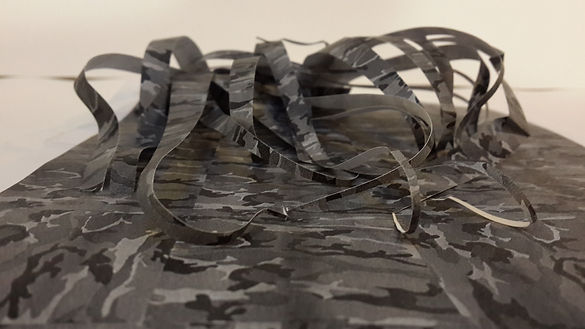


My conceptual models in chronological order


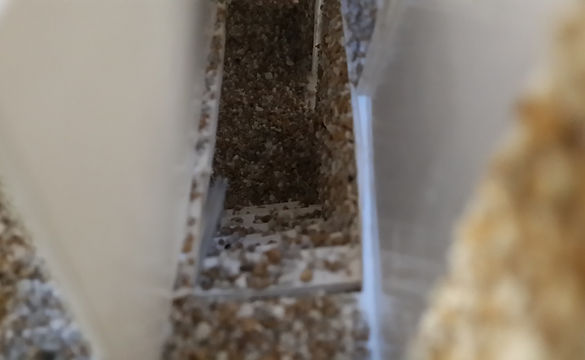
My final 1:50 scaled model


My final presentation boards for my Visitor Interpretive Centre